You Don't Need a Fire to Keep the Firehouse Open
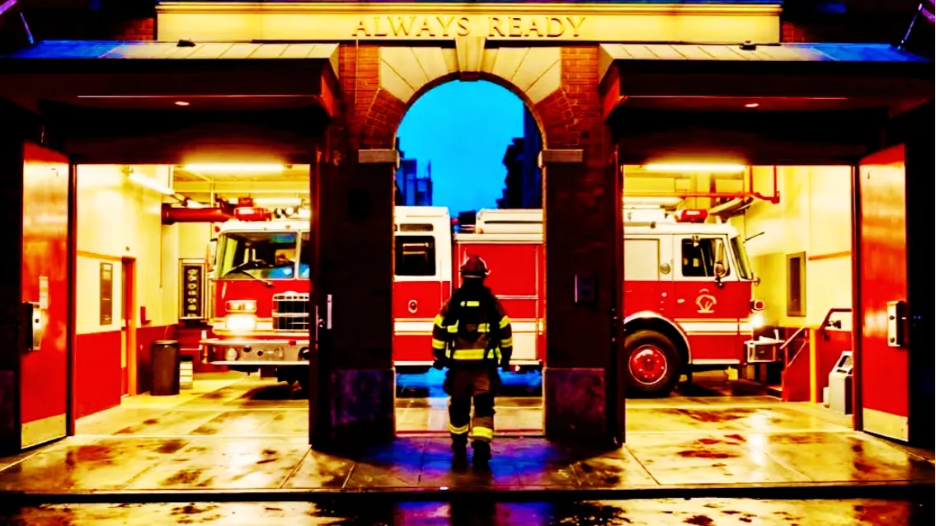
Some things are maintained for the days we hope never come.
In my book, Reclaiming Respect, I wrote about the men and women who run toward danger while the rest of us run away. Firefighters, police officers, EMTs, members of our military. They exist because chaos will come and because order does not maintain itself. It must be safeguarded, in advance, by institutions we keep ready before the sirens sound.
Of all the chapters I’ve written, that one has drawn more responses from readers than any other. Everyone, deep down, knows what a civilization owes the people who stand between them and the worst day of their lives. Respect for first responders, I wrote, is not optional. It is essential… not honor after tragedy, but readiness before it.
Six days after 9/11, I visited a New York City firehouse. A three-hour line of mourners stretched down the block. One surviving firefighter greeted us. Nobody in that line was debating whether the firehouse was necessary. Crisis had answered the question.
Deterrence is a reason to keep something, even when nothing is burning.
My dear friend Martin “Marty” Cooper, inventor of the mobile phone, has warned about this for decades. In words I quote in my book, he said: “No one will win the next big war. The tools of war are transitioning from costly armies, battleships, and tanks to inexpensive missiles and drones that can deliver destruction beyond imagination.”
Now we’ve seen the fire.
This October, riots swept across France. Roughly 1,500 businesses were looted or damaged. France’s retail federation expected the count to pass 2,000. Family-run shops, Forbes reports, may never recover. Hundreds of millions of euros in losses. Store owners standing guard over their own storefronts while whole streets were wrecked. This is what the gap between a mob and the response actually costs and the people who pay are never the policymakers. They are the ones behind the shattered glass.
Here in New York, the city has announced the disbanding of the NYPD’s Strategic Response Group, the unit built for exactly those scenes: mass unrest, terror response, the hours when ordinary policing is not enough. Some call it reform.
I will not pretend neutrality: a promise to keep people safe and the dismantling of a crisis unit, delivered back-to-back, is a contradiction the public deserves to have resolved, before, not after.
When the mob comes and history says it comes, who arrives, and how fast?
A firehouse is not maintained because fires are frequent. It is maintained because one fire, unrestrained, takes everything. We don’t need a fire to justify the firehouse. We need only the honest memory of what happens when no one is ready.
The Room Where You’re Not Heard
Now the part I keep hearing from New Yorkers. I’ll be transparent: I no longer live in the state. Still, as Billy Joel sang, I’m still in a New York State of mind and when I went looking for the direct channel to the mayor myself, distance didn’t make the wall any shorter.
I found a webform limited to 500 characters. Half a tweet, to the chief executive of the largest city in America. If that’s what reaching City Hall feels like from afar, imagine what it feels like from the corner bodega. We are told to speak. We are not built a room to speak in.
Safety cannot be a slogan for election season and a presumption after the votes are counted.
So, use what exists and make it impossible to pretend you didn’t:
Tell your council member. Find yours at council.nyc.gov. Every member lists a district office with a real phone number and staff whose job is to log constituent calls. Counts drive agendas.
Testify. The Council accepts testimony at every public hearing in person, by Zoom, or in writing. Register at council.nyc.gov/testify at least 24 hours before, or email written testimony to testimony@council.nyc.gov up to 72 hours after the hearing ends, with the hearing date in your subject line. Two minutes of a citizen speaking enters the permanent record.
Put 311 on record. Call 311 or text 311-692. Service requests are logged, tallied, and published on a public dashboard. Volume becomes data. Data becomes leverage.
Ask three questions, everywhere, every time: Why was this built? What crisis was it for? Who answers when that crisis returns? If those questions go unanswered, the form bounces, the voicemail fills, the record closes that silence is itself the answer and we will have learned, once again, that readiness is only respected after it is gone.
Respect for readiness, for responders, for the reasons things were built is not nostalgia. It is how a city survives its worst days.
The views expressed in this newsletter are solely those of the author in his personal capacity and do not reflect his official position of Destination Peace or any other organization with which he is affiliated. This article is commentary on matters of public policy and is not professional advice.