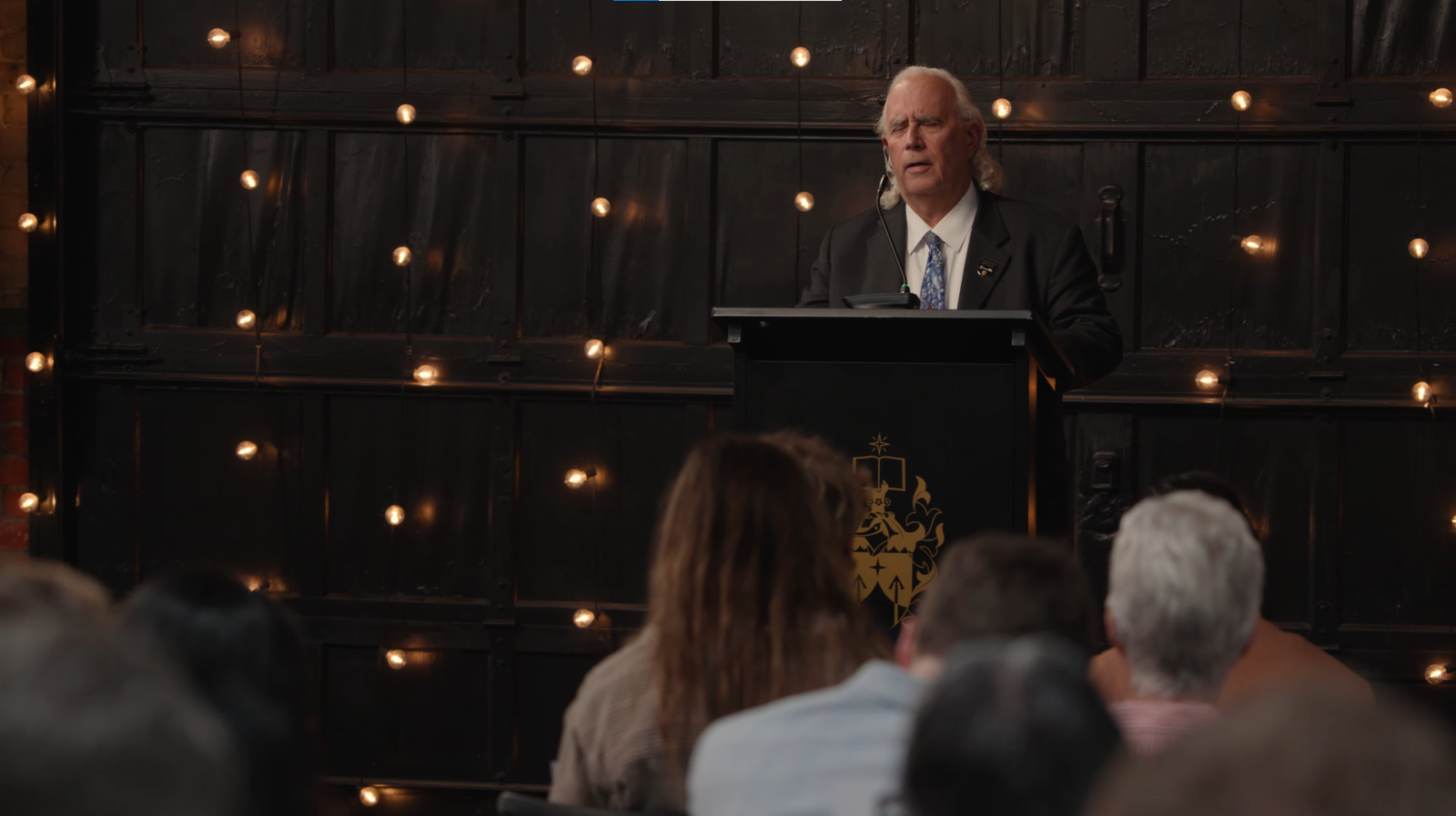
Sonic Diplomacy™ – When Sound Becomes the Language of Peace
When the Voice Stops Belonging to the Singer There is a moment in performance when the voice stops belonging to the singer. It transfigures into the room, into the ears of strangers, into something that can only be called shared. It is in that transfigured, borderless moment that I first understood what I would eventually name Sonic Diplomacy™ in practice: the proposition that sound, offered with intention, can do what treaties, summits, and declarations so often cannot. It can make enemies breathe together. I did not arrive at this idea from a library. I arrived at it from a lifetime of standing at a microphone in sacred spaces, from fifty years as a cantor and lyric tenor, from the particular alchemy of synagogue walls that taught me how a single phrase of melody could steady a grieving family, open a closed heart, or as I once witnessed in a pastoral setting at a Johns Hopkins hospital reach a patient whom no physician, no social worker, no language had been able to touch. Music reached him. That moment became a compass. A Grammy as Proof: Chandrika Tandon and the Argument Music Won It is with that same compass in hand that I have had the privilege of sharing a stage with Grammy Award-winning artist Chandrika Tandon, whose 2025 Grammy win for Triveni, a luminous collaboration with South African flutist Wouter Kellerman and Japanese cellist Eru Matsumoto, stands as one of the most eloquent proofs of Sonic Diplomacy’s central thesis. Triveni does not merely blend musical tra
When the Voice Stops Belonging to the Singer
There is a moment in performance when the voice stops belonging to the singer. It transfigures into the room, into the ears of strangers, into something that can only be called shared. It is in that transfigured, borderless moment that I first understood what I would eventually name Sonic Diplomacy™ in practice: the proposition that sound, offered with intention, can do what treaties, summits, and declarations so often cannot. It can make enemies breathe together.
I did not arrive at this idea from a library. I arrived at it from a lifetime of standing at a microphone in sacred spaces, from fifty years as a cantor and lyric tenor, from the particular alchemy of synagogue walls that taught me how a single phrase of melody could steady a grieving family, open a closed heart, or as I once witnessed in a pastoral setting at a Johns Hopkins hospital reach a patient whom no physician, no social worker, no language had been able to touch. Music reached him. That moment became a compass.
A Grammy as Proof: Chandrika Tandon and the Argument Music Won
It is with that same compass in hand that I have had the privilege of sharing a stage with Grammy Award-winning artist Chandrika Tandon, whose 2025 Grammy win for Triveni, a luminous collaboration with South African flutist Wouter Kellerman and Japanese cellist Eru Matsumoto, stands as one of the most eloquent proofs of Sonic Diplomacy’s central thesis. Triveni does not merely blend musical traditions; it resolves the concept of musical borders altogether. Ancient Sanskrit mantras breathe alongside the flute of southern Africa and the cello of Japan, and the result is not a fusion so much as a recognition, the recognition that beneath every tradition’s sonic vocabulary lies the same human longing. Chandrika has not only won a Grammy, but she has also won an argument. The argument that the world can be healed, one mantra at a time.
The morning before we shared the stage, Chandrika stood before one hundred women scientists in a packed conference room and delivered a message that stopped the room cold. She spoke with fire, her conviction unmistakable, and the room glowed with the light of her perfect message about perfection. That she could move a roomful of researchers and scholars with the same interior authority she brings to a concert hall is itself a demonstration of Sonic Diplomacy in action, proof that the voice, when it carries truth, requires no instrument other than itself. She walked from that room and onto our stage carrying that message and the afterglow of those hundred women with her.
A Shared Teacher, a Common Thread
What Chandrika and I share goes deeper than a stage. We share a teacher.
Professor William Riley has been the invisible thread beneath both of our voices, mine for thirty years, Chandrika’s for thirty-two. That a single teacher’s instruction in breath, resonance, and intention has shaped two artists who have each traveled to opposite ends of the world’s spiritual and musical traditions is itself a kind of diplomacy. Prof. Riley did not only teach singing. He taught that the voice is only as true as the intention behind it. Sound without meaning is noise. Sound with meaning, anchored in breath, in body, in the honest intention of the singer is a form of speech that bypasses every ideological firewall the human mind has ever constructed.
Sasha Eha Tozi Hawoo®: The Phrase Built for Every Language
My own contribution to this field began eleven years ago when I created an eight-syllable phrase: Sasha Eha Tozi Hawoo®. The phrase was designed to replicate sonic elements present in 124 global languages from their word peace, a sound that belongs, in some small way, to all of them. When communities from radically different backgrounds sing it together, something predictable happens: the strangeness sublimates. The shared vibration precedes the shared meaning, and the shared meaning follows. This is not metaphor. This is the mechanism of Destination Peace, the organization I founded to carry this work into conflict zones, classrooms, diplomatic chambers, and concert halls across the world.
To understand the origins and inspirations behind this work, read What Inspired the Birth of Sonic Diplomacy™.
Sound Before Diplomacy: What Beethoven Understood First
I named this mechanism Sonic Diplomacy because diplomacy, at its most fundamental, is the art of finding a common language before the negotiation begins. Ludwig van Beethoven understood this long before the modern diplomat. Inscribing his Missa Solemnis, one of the most profound musical petitions for peace ever composed, with the words “From the heart, may it go to the heart,” Beethoven identified what political frameworks have never fully mapped: that the deepest human reconciliation begins not in the mind but in the body, not in argument but in resonance. Traditional diplomacy arrives with translators, protocols, and the entire apparatus of differentiation.
Sonic Diplomacy in practice arrives first, and it arrives in a register that the nervous system, not the intellect, receives. Music addresses fear through co-regulation of breath and rhythm; it confers honor by treating every participant’s voice as essential; and it reframes interest, if only for the duration of a song, around the shared goal of harmony.
Triveni and the Confluence of Cultures
Chandrika’s Triveni operates precisely at this intersection. The album’s title, a Sanskrit word for the confluence of three sacred rivers, is a perfect metaphor for what Sonic Diplomacy proposes at scale: that cultures, like rivers, do not lose themselves in confluence. They become something larger. Her music has reached listeners across faith traditions, nationalities, and political contexts in ways that policy papers cannot, not because it avoids complexity, but because it addresses the part of the human being that is prior to complexity.
The Stage That Was Ready: Helen Corning Warden Theater
It is worth pausing on the setting itself. We performed at the Helen Corning Warden Theater of the Academy of Vocal Arts in Philadelphia, a hall built in 1902, adorned with tableaux drawn from Shakespeare’s A Midsummer Night’s Dream, a mosaic fireplace, carved wooden beams, and oil-on-canvas paintings that have witnessed more than a century of the human voice at its most disciplined and most free. That the 55th Annual Voice Foundation Symposium chose this consecrated space as its stage was no accident. Some rooms are built to hold the weight of what music asks of us. The Helen Corning Warden Theater is one of them. Sonic Diplomacy™ in practice found, in that room, a home it did not know it had been looking for.
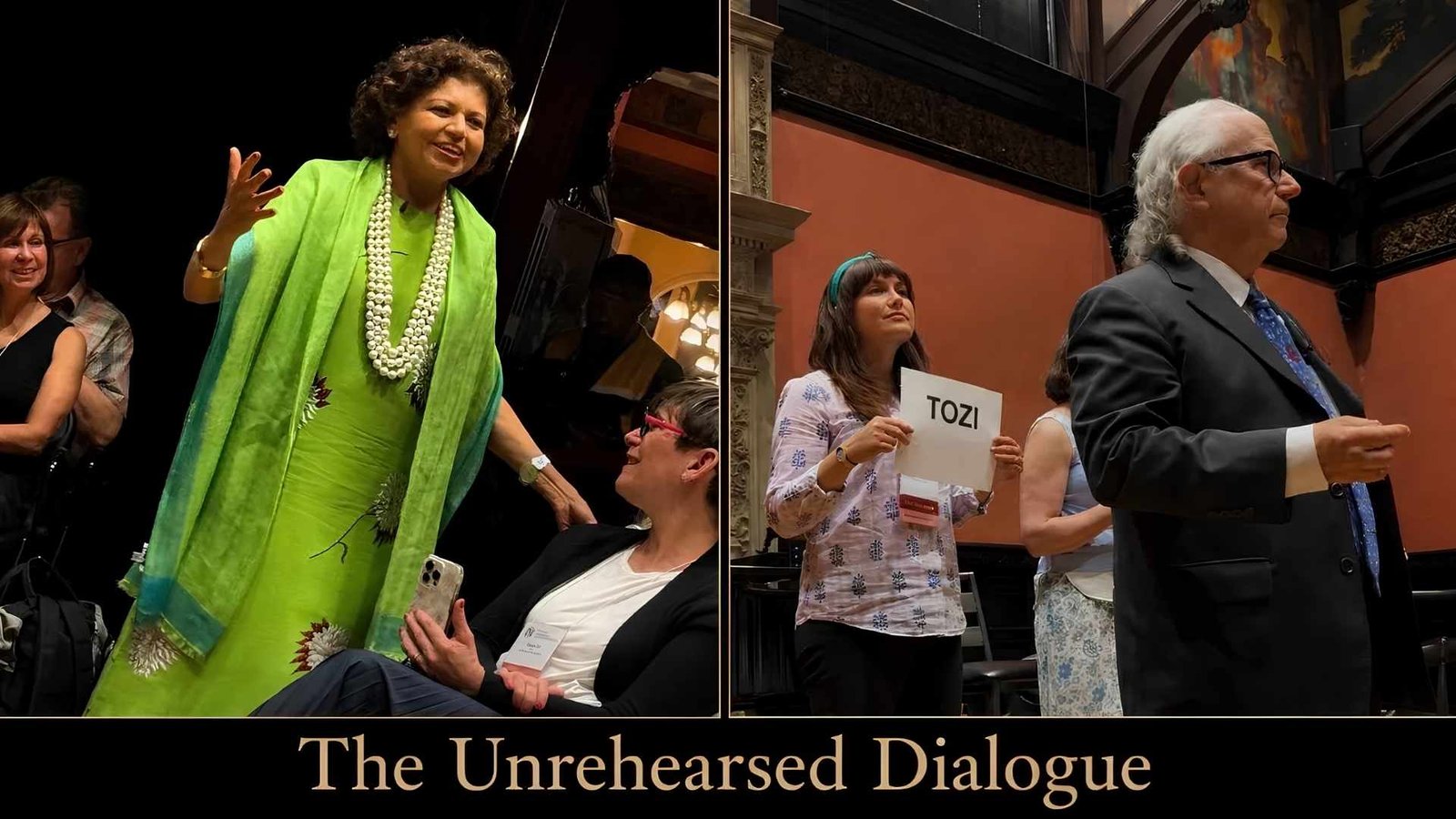
Before we took the stage, a professional media production company captured what no symposium program could have scheduled: Chandrika and I improvising antiphonally, her chanting traditions meeting mine in an unrehearsed dialogue that needed no common language because it already had one. That moment, still awaiting its proper stage, may be the purest proof of everything written here.
The Work Continues: A Breath at a Time
I am not a detached theorist of this phenomenon. I am its practitioner, its subject, and through the grace of a long career and the mentorship of a remarkable teacher its grateful witness. As a cantor, I have stood between the sacred and the human for five decades. As an author and world traveler, I have tested these ideas against the friction of real communities in real conflict. As the founder of Destination Peace, I have built an infrastructure for delivering them. As a doctoral candidate, I am now attempting to do the hardest thing of all: to find language adequate to what the music already knows.
That is the work of Sonic Diplomacy in practice. It begins, as all good music does, with a breath.